
Orpington Benefits Bill Nears £196 Million as Welfare Spending Rises 21.6%
New figures show that welfare spending in the Orpington constituency has reached almost £196 million a year, with the local benefits bill rising sharply over the past two years.
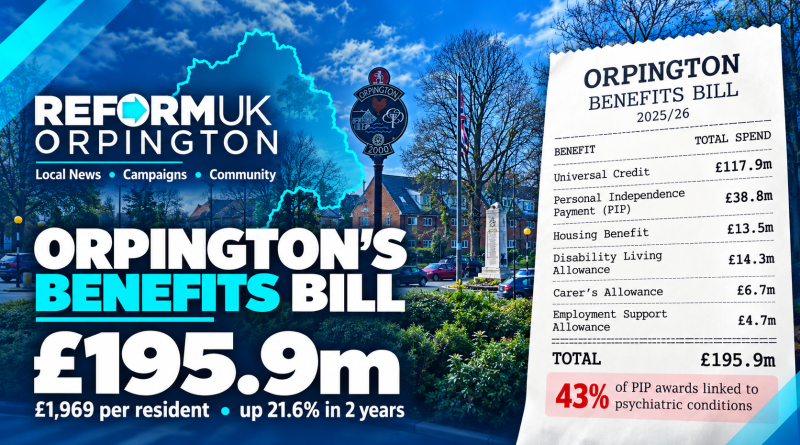
According to the TaxPayers’ Alliance Welfare Map, Orpington’s total spending across six major benefits reached £195,884,703 in 2025/26.
That works out at around £1,969 per resident and represents an increase of 21.6% in just two years.
The figures also show that Orpington ranked 352nd out of 575 constituencies for total welfare spending.
For comparison, the median local wage is listed at £38,358, having risen by 15.2% over the same two-year period.
The figures underline just how quickly welfare spending is growing locally.
Universal Credit Accounts for the Largest Share
By far the biggest part of Orpington’s welfare bill is Universal Credit, with annual spending of:
£117,893,424
That equates to around £1,185 per resident, with 8,293 households claiming Universal Credit.
The figures also show that around 1 in 20 working-age adults in Orpington are assessed as having Limited Capability for Work and Work-Related Activity.
The next largest area of spending is Personal Independence Payment, at:
£38,751,658
There are 5,152 PIP claimants in the constituency, with spending equivalent to around £389 per resident.
The number of PIP claimants has risen by 22% in two years.
The figures also show that 42.8% of PIP awards in Orpington are for psychiatric conditions.
Other major areas of spending include:
- Disability Living Allowance: £14,296,820
- Housing Benefit: £13,479,634
- Carer’s Allowance: £6,739,757
- Employment Support Allowance: £4,723,409
Taken together, the scale of spending is considerable for a single constituency.
Bromley-Wide Bill Now Above £608 Million
The Orpington figures also form part of a much bigger picture across the borough.
Across the London Borough of Bromley, spending on the same six benefits has now reached:
£608,974,584 a year
That is equivalent to around £1,816 per resident and represents a 20.6% increase in two years.
Universal Credit alone accounts for more than £372 million across Bromley.
PIP spending stands at more than £113 million, while Housing Benefit adds another £53.6 million.
For a borough that has been Conservative-controlled for decades, these figures raise obvious questions.
National welfare policy is not set by Bromley Council, but the Conservatives have dominated local and national politics for years while spending has continued to rise.
The result is that taxpayers are being asked to fund an ever-growing welfare bill while also facing pressure on policing, defence, roads, infrastructure and local services.
Reform UK: Welfare Must Be Sustainable
Reform UK has consistently argued that the welfare system must continue to support people who genuinely need help, but that the system also has to be affordable.
That means looking seriously at eligibility, work incentives, long-term sickness claims, fraud, abuse and whether the system is doing enough to help people back into employment where they are able to work.
The issue is not about attacking those who genuinely need support.
It is about recognising that welfare spending cannot continue rising at this rate indefinitely without consequences elsewhere.
In Orpington alone, the bill is now approaching £200 million a year.
Across Bromley, it is already above £608 million.
Those are not small figures.
They represent a growing share of public spending at a time when taxpayers are already under significant pressure.
The Conservatives Have Failed to Get a Grip
For years, the Conservatives talked about controlling welfare spending, reducing dependency and rewarding work.
Yet the figures tell a very different story.
In Orpington, spending is up 21.6% in two years.
Across Bromley, it is up 20.6%.
That is not evidence of a system being brought under control.
It is evidence of a welfare state that continues to expand while successive governments avoid the difficult decisions needed to make it sustainable.
Reform UK believes those decisions can no longer be postponed.
Support should be there for those who genuinely need it.
But taxpayers also deserve confidence that the system is fair, properly targeted and financially sustainable.
For Orpington residents, these latest figures show that the welfare debate is not something happening somewhere else.
It is happening here too.